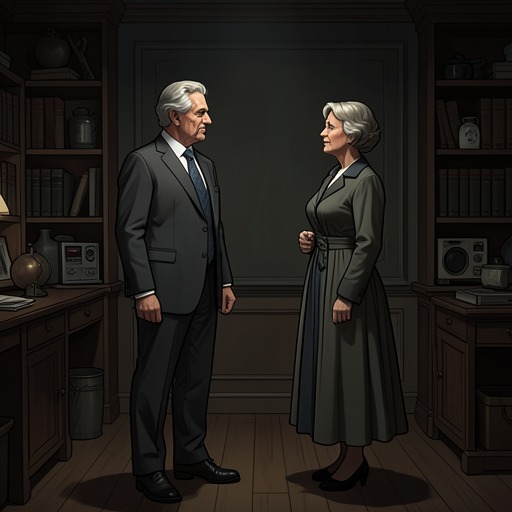
Georges Picquart and Pauline’s long-running affair
An Officer and a SpyGeorges Picquart and Pauline Monnier’s long-running affair is a relationship of deep historical intimacy without a shared domestic future. They have been bound together since childhood, survived siege and exile, and resumed their love affair after years apart. Yet Pauline remains with Philippe and their daughters, while Picquart recognizes that he does not want her to leave. Their bond is sustained by a past neither can relinquish, but the novel refuses to treat that history as a promise of marriage.
Identity and Duration
Picquart describes a relationship that has lasted, in one form or another, for more than twenty years. The duration matters because it exceeds a brief romance or isolated episode: their connection recurs across distinct periods of their lives, including separation, other commitments, and reunion. Picquart considers that longevity almost equivalent to marriage, but Pauline rejects the comparison. Her weary answer marks a difference between the length of their attachment and the kind of life they have actually made together.
The relationship is explicitly an affair, not a marriage. Pauline has a life with Philippe and two daughters; Picquart’s account makes clear that their intimacy continued after she had formed that family. The evidence supports a durable attachment, but not a shared household or an eventual union. Its endurance is therefore inseparable from its limits.
A Shared Past, and a Return
Picquart and Pauline grew up together in Alsace. They survived the siege together and later clung to one another during exile, when, as Picquart recalls, everything else had gone. He was her first lover. These memories make their bond older than its later adult form: it is founded not only on desire, but on having endured upheaval together.
Picquart believes he should have proposed to Pauline before leaving to join his regiment in Algeria. Instead, he assumes there will be time later. After his foreign service and his return from Indochina, Pauline has given up on him, has a daughter, and is pregnant with a second. Picquart says he does not mind very much; soon, the affair resumes where it had stopped. That resumption is a reversal, but not a resolution. They recover their intimacy without undoing the separate life Pauline has established.
For years, Picquart makes the past their substitute for a future together. The formulation once serves as a way to accept what they do not build. When he recalls it, however, he is no longer certain he believes it. The doubt does not erase their history; it exposes the cost of relying on that history as though it could answer the question of what comes next.
Intimacy and Its Limits
During Picquart’s mother’s final illness, he returns each evening from the office to sleep in the spare bedroom at Versailles. Pauline is among those who visit. One night he finds her at his mother’s bedside, reading aloud to her despite her unresponsive state. After Pauline puts down the book and rises to embrace him, Picquart holds on to her and says that this time he does not think he will ever let her go.
The scene brings their private attachment into a family vigil. Pauline immediately recalls that Picquart’s mother is present, even though she cannot respond. Picquart answers that his mother would have been delighted by their relationship and had never understood why they were not married. His confidence contrasts with Pauline’s attention to the social boundary still surrounding their intimacy. They glance toward the impassive, unconscious woman; the moment’s tenderness does not remove the difference between Picquart’s wish to hold Pauline and the life she has chosen to maintain.
Picquart takes Pauline’s hand and invokes their more than twenty years together as a kind of marriage. Pauline’s reply is affectionate in address but unequivocal in substance: their relationship is nothing like one. When Picquart’s sister arrives, Pauline immediately pulls her hand away. The gesture is brief, but it shows how quickly a private closeness yields to the presence of family and the conventions their relationship has never displaced.
Recognition and Choice
In a later conversation, Anna tells Picquart that Pauline will never leave Philippe because of the girls. Picquart is startled that Anna knows about the affair; she replies that everyone has known for years. His irritation at this revelation suggests that a relationship he has experienced as private has long been visible to those around him. Its secrecy is not a reliable measure of its social concealment.
Picquart challenges Anna’s assumption that he wants Pauline to leave her husband. He says he does not, and Anna agrees. Her response identifies the relationship’s central impasse: the obstacle is not simply that Pauline will not choose Picquart. Picquart, too, accepts the arrangement that keeps them apart from a shared future. The affair persists through attachment, memory, and reunion, while both its duration and its limits remain in view. It is neither a belated marriage nor a clean separation, but a lasting bond whose past cannot make it into a life together.